The True Cost of Manual Processes
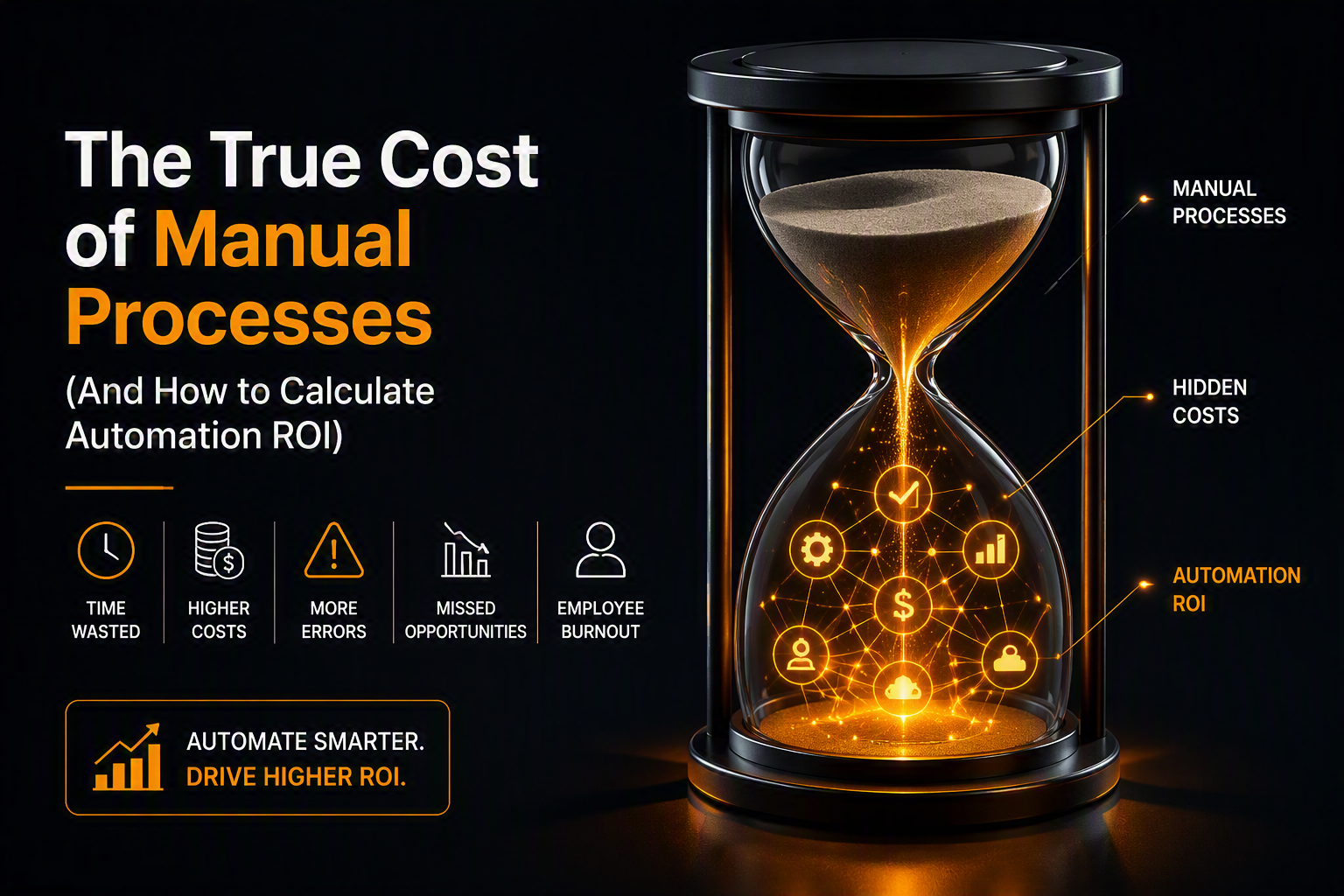
Stop Treating Manual Work as "Free" Labor
Many B2B executives hesitate to invest in custom software or workflow automation because the upfront development cost looks like a significant line-item expense. Meanwhile, paying employees to manually re-type data, copy information across spreadsheets, and chase down project updates feels like a routine, fixed operational cost. This perspective is a costly financial illusion. Manual processes are not free—they carry heavy, compounding expenses that quietly erode your gross margins every single day.
This guide breaks down the true, hidden expenses of manual work, provides a concrete formula for calculating automation ROI, and shows how replacing repetitive tasks with custom software directly accelerates enterprise value.
📍 What Is the "Manual Process Tax"?
The Manual Process Tax is the total financial burden your business absorbs by using human labor for repetitive, rule-based data tasks that could be handled instantly by software. This includes direct payroll waste, opportunity costs, expensive human data-entry errors, and delayed revenue recognition.
Why It Matters:
- Payroll Waste: Knowledge workers spend up to 30% to 40% of their working hours on repetitive administrative tasks and manual data management.
- The Error Rate Factor: Manual data entry carries an average error rate of 1% to 4%. In high-ticket B2B operations, a single misplaced digit on an invoice or contract can cost thousands to rectify.
- Valuation Impact: Businesses anchored by manual, human-dependent processes sell at significantly lower EBITDA multiples than firms powered by proprietary, automated software systems.
🧠 Understand the Anatomy of Manual Costs
To evaluate the true expense of manual work, you must look beyond base salaries and measure the full operational ripple effect.
Key Components:
- Direct Labor Cost: The actual hourly rate paid for time spent on low-value administrative tasks.
- Opportunity Cost: The lost revenue your team could have generated if those hours were spent on high-value client acquisition or billable work.
- Process Latency: The financial cost of waiting hours or days for a human to complete a task that an API performs in 200 milliseconds.
- Employee Burnout: High turnover driven by talented professionals being forced to perform tedious, mind-numbing data entry.
🗺️ The Step-by-Step Formula for Calculating Automation ROI
You don't need to guess whether custom software or API automation is worth the investment. You can calculate the exact payback period using basic financial metrics.
Steps to Calculate Your ROI:
- Identify the Process: Target a specific, repetitive task (e.g., manually generating onboarding packages and invoices).
- Calculate Hourly Rate (H): Take the annual salary + overhead of the employee performing the task and divide by 2,000 hours.
- Calculate Time Spent (T): Determine the number of hours spent on this task per week across your entire team.
- Determine Annual Manual Cost (C): Multiply H × T × 52 weeks.
- Estimate Automation Cost (A): Get a fixed quote for engineering the custom software solution.
- Calculate Payback Period: Divide A / C. This tells you exactly how many months it takes for the software to pay for itself completely.
Pro Tip: Always factor in the "Opportunity Cost Multiplier." If a senior account manager billing $150/hr spends 5 hours a week doing $20/hr admin work, your true loss isn't $100/wk—it's $750/wk in missed billable capacity.
📝 Eliminate the Hidden Error Tax
When humans process data manually, mistakes are mathematically inevitable. A single wrong address in a shipping manifest, a missed field in a CRM profile, or a miscalculated discount code can delay an entire billing cycle or cause a client to cancel. By replacing manual entry with validated custom API routes, your error rate drops to zero, saving your operations team dozens of hours of monthly "damage control."
🌐 Accelerate Revenue Recognition
Manual processes slow down your cash flow loop. If it takes your team 3 days after project completion to manually compile deliverables, draft an invoice, and email it to the client, you have artificially added 72 hours to your Days Sales Outstanding (DSO). Custom-engineered software links milestone completions directly to payment gateways, generating and delivering invoices the exact millisecond the work is approved. 📊 Contact For a Free Business Assessment
⭐ Replace Fragile Spreadsheets with Structured Databases
Most scaling businesses run their core operations on massive, sprawling Google Sheets or Excel files.
The Spreadsheet Hazard:
- No audit trails or granular permission controls.
- One accidental cell deletion can break complex financial formulas across the entire sheet.
- Extremely slow performance when handling thousands of rows.
- Zero ability to handle concurrent, real-time API connections safely.
Transitioning from spreadsheets to a structured database like Supabase or PostgreSQL provides instant speed, rock-solid stability, and total data integrity.
🔗 Build Equity Value with Proprietary Software Assets
When you pay for manual labor or rent off-the-shelf SaaS tools, that money is gone forever. When you invest in custom software that automates your core operational workflows, you convert an operational expense into an owned intellectual property asset. Private equity buyers and acquirers pay premium valuation multiples for companies with automated, repeatable systems that operate independently of key personnel.
📱 Empower Your Remote Workforce
Manual processes usually rely on "tribal knowledge"—asking the person sitting next to you how to handle a specific edge case. In a remote or hybrid environment, this causes massive friction and communication delays. Custom software embeds your business rules directly into the user interface, allowing remote team members to execute complex workflows flawlessly without needing constant supervision.
📊 Track Your True Process Efficiency Metrics
When you automate manual workflows, you transform operational performance into clear, actionable data.
Metrics to Watch:
- Cost Per Transaction / Process Completed.
- Process Execution Time (Hours vs. Milliseconds).
- Full-Time Equivalent (FTE) Capacity Reclaimed.
- Payback Period on Software Development.
🧩 Advanced Process Automation Strategies
Ready to eradicate manual work across your stack? Try these:
- Event-Driven Architectures: Build custom microservices that monitor your database and automatically execute downstream actions (e.g., generating PDFs or sending SMS updates) whenever a record changes.
- Automated Document Generation: Eliminate manual contract drafting by dynamically injecting database values into standardized HTML templates and converting them to downloadable PDFs on demand.
- Intelligent Data Parsing: Deploy optical character recognition (OCR) and custom AI models to automatically extract key metadata from incoming receipts, invoices, and physical documents.
💡 Final Thoughts
Manual processes are a hidden tax that quietly drains your company's profitability, slows down your growth, and caps your business valuation. Custom software and workflow automation are not luxury expenses; they are strategic capital investments that yield immediate, compounding returns by reclaiming hundreds of wasted labor hours.
🚀 Talk to a Growth Engineer Today