Headless Architecture for B2B
Stop Rebuilding Your Entire Stack Every Three Years
The traditional approach to B2B software engineering ties your content management system, user interface, business logic, and database together into a single, rigid monolith. When you want to update your design, launch a mobile application, or expand into a new digital touchpoint, you are forced to re-engineer the entire system from scratch. This legacy pattern creates massive technical debt, slows down innovation, and inflates software maintenance budgets.
This guide breaks down why leading B2B enterprises are adopting "Headless Architecture"—a decoupled engineering model that separates the presentation layer from backend business logic, giving you complete flexibility to scale and future-proof your digital operations.
📍 What Is Headless Architecture?
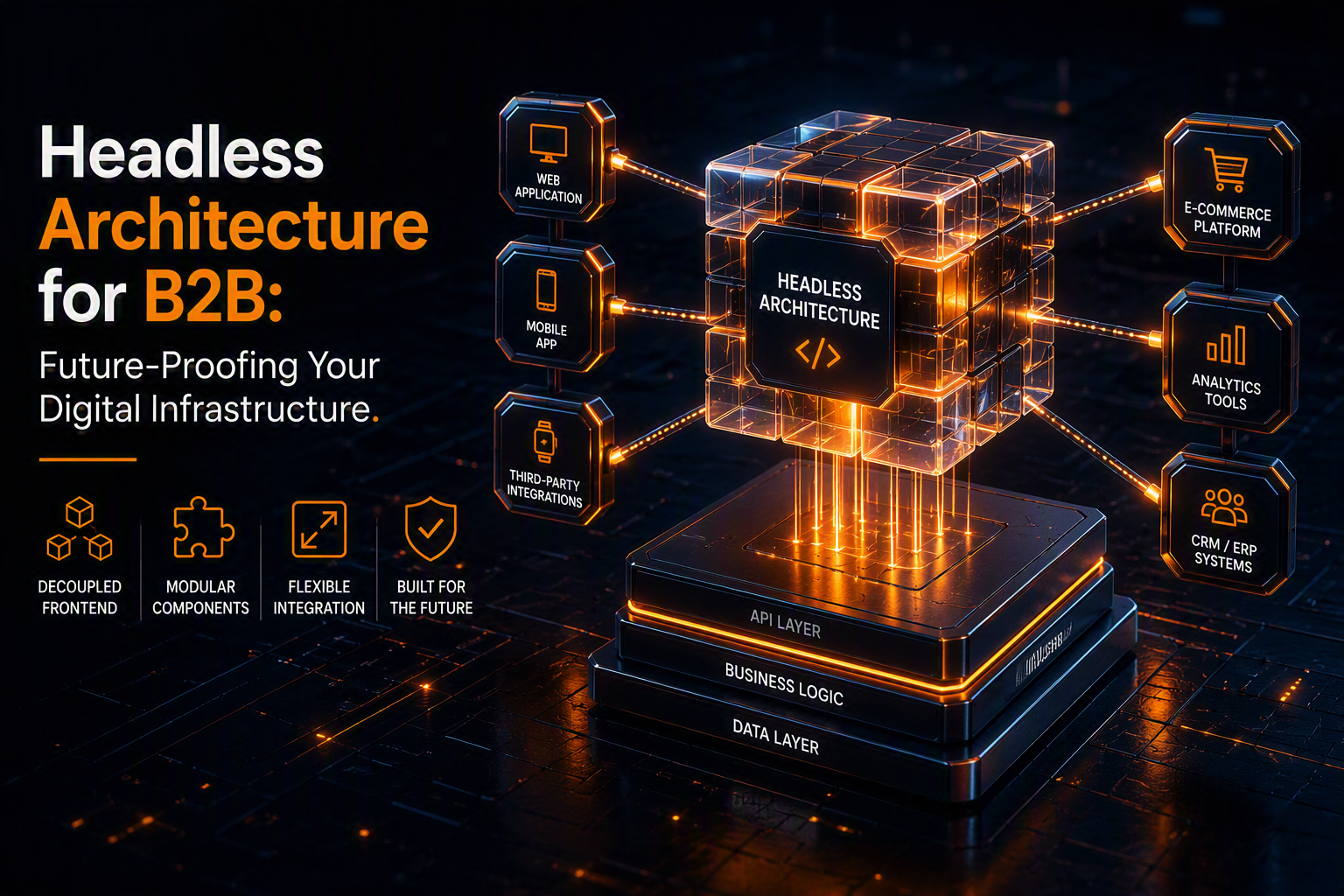
Headless Architecture is an engineering design pattern where the frontend ("head") is decoupled from the backend ("body"). Instead of a monolithic CMS generating hardcoded HTML pages, the backend acts strictly as an API server, delivering raw data to any custom frontend framework (like Next.js) or device via secure Web APIs.
Why It Matters:
- Omnichannel Scalability: Write backend logic once and expose it via APIs to websites, mobile apps, customer portals, or IoT devices simultaneously.
- Developer Velocity: Frontend designers can build cutting-edge interfaces without risking breaking core database or backend payment workflows.
- Security Isolation: Because the public frontend is completely separated from the core database, your underlying infrastructure is significantly harder to target.
🧠 Understand the Decoupled Architecture
To appreciate headless architecture, you must examine how data flows through a modern API-first ecosystem.
Key Components:
- The Head (Frontend): Custom Next.js, React, or mobile applications optimized exclusively for user experience.
- The API Layer (REST/GraphQL): The secure digital pipeline transferring structured JSON data between system layers.
- The Body (Backend & CMS): Headless databases (like Supabase) or headless content repositories managing business logic, user auth, and content records.
- The Integration Layer: Third-party microservices (Stripe for billing, HubSpot for CRM, Algolia for search) hooked directly into the API pipeline.
🗺️ Audit Your Architecture for Rigidity
Is your current software setup blocking business agility? Look for these classic monolithic failure points.
Signs You Need a Headless Upgrade:
- Updating a simple website design element requires risky changes to core database templates.
- Launching a native iOS or Android app requires building a completely separate backend infrastructure from scratch.
- Page load speeds remain slow despite aggressive caching because your server must process heavy backend scripts on every request.
- Integrating a new third-party software requires complex custom plugins rather than standard API connections.
Pro Tip: Perform a "Touchpoint Audit." Count how many digital interfaces your business uses (website, client portal, internal admin tool, mobile app). If each tool runs on a separate database or backend, you are paying a massive "duplication tax."
📝 Accelerate Performance with Static & Serverless Rendering
Monolithic systems compile database queries and HTML every time a user visits a page, creating unavoidable server latency. In a headless setup, frontend frameworks like Next.js pull content from the API during build time or at the server edge. The browser receives lightweight, pre-compiled HTML and JavaScript in milliseconds. This decoupling delivers blistering load speeds, near-zero server strain, and vastly improved SEO rankings.
📊 Contact For a Free Business Assessment🌐 Unify Disconnected Frontends Across Your Enterprise
In traditional setups, your main website, customer portal, and mobile app run as isolated software silos. Headless Architecture solves this by creating a single source of truth. Your backend Supabase or PostgreSQL database serves as the universal engine. Whether a client updates their profile on your Next.js website or through a mobile app, the underlying API updates the database once, reflecting the change across all platforms instantaneously.
⭐ Replace Monolithic Lock-In with Modular Microservices
When you run a monolithic platform, you are locked into its native features, payment processing, and database limits. Headless Architecture adopts the "Best-of-Breed" philosophy. You pick the exact best tool for each specific job: Supabase for database and auth, Stripe for payments, Algolia for instant site search, and Vercel for edge hosting. If you ever want to swap out your search engine or payment processor, you simply update an API endpoint without rebuilding your core software.
🔗 Enhance Enterprise Security Capabilities
Exposing a monolithic server (where your code, database, and admin panel sit in one place) creates an expansive attack surface for malicious actors. By decoupling your application, the frontend web server contains zero sensitive database code or credentials. Public users interact exclusively with pre-rendered pages or secure edge functions. Even if a public endpoint experiences an attack, your underlying database and backend business logic remain safely isolated behind private API gateways.
📱 Future-Proof Your Business for Emerging Tech
Technology evolves rapidly. In a monolithic environment, adopting a new technology standard requires a full system rewrite every few years. With Headless Architecture, your core backend logic and database outlive any frontend design trend. When new devices, AI interfaces, or web frameworks emerge, you simply build a new "head" and connect it to your existing, rock-solid API infrastructure.
📊 Track Your Architecture Efficiency
Decoupling your software yields measurable operational gains across performance, security, and development velocity.
Metrics to Watch:
- Frontend Deployment Speed (Time to launch new UI features).
- API Response Times (Sub-100ms benchmarks).
- Infrastructure Maintenance & Refactoring Costs.
- System Uptime and Resilience during traffic spikes.
🧩 Advanced Headless Strategies
Ready to engineer an enterprise-grade API ecosystem? Try these:
- GraphQL Data Querying: Implement GraphQL to allow your frontend applications to request only the specific data fields needed for a screen, minimizing payload size and accelerating mobile connections.
- Edge Personalization: Pass user metadata through serverless edge functions to dynamically swap out headlines, calls to action, and regional pricing before the pre-rendered page hits the browser.
- Composable Commerce: Decouple your pricing, inventory, and checkout engines to build completely custom, high-converting B2B buying experiences that bypass traditional shopping cart friction.
💡 Final Thoughts
Headless Architecture is not just a technological trend; it is a fundamental shift in how modern B2B software is engineered. By decoupling your frontend interface from your backend business logic, you eliminate technical debt, enhance security, maximize performance, and build a modular digital asset that adapts effortlessly as your company grows.
🚀 Talk to a Growth Engineer Today